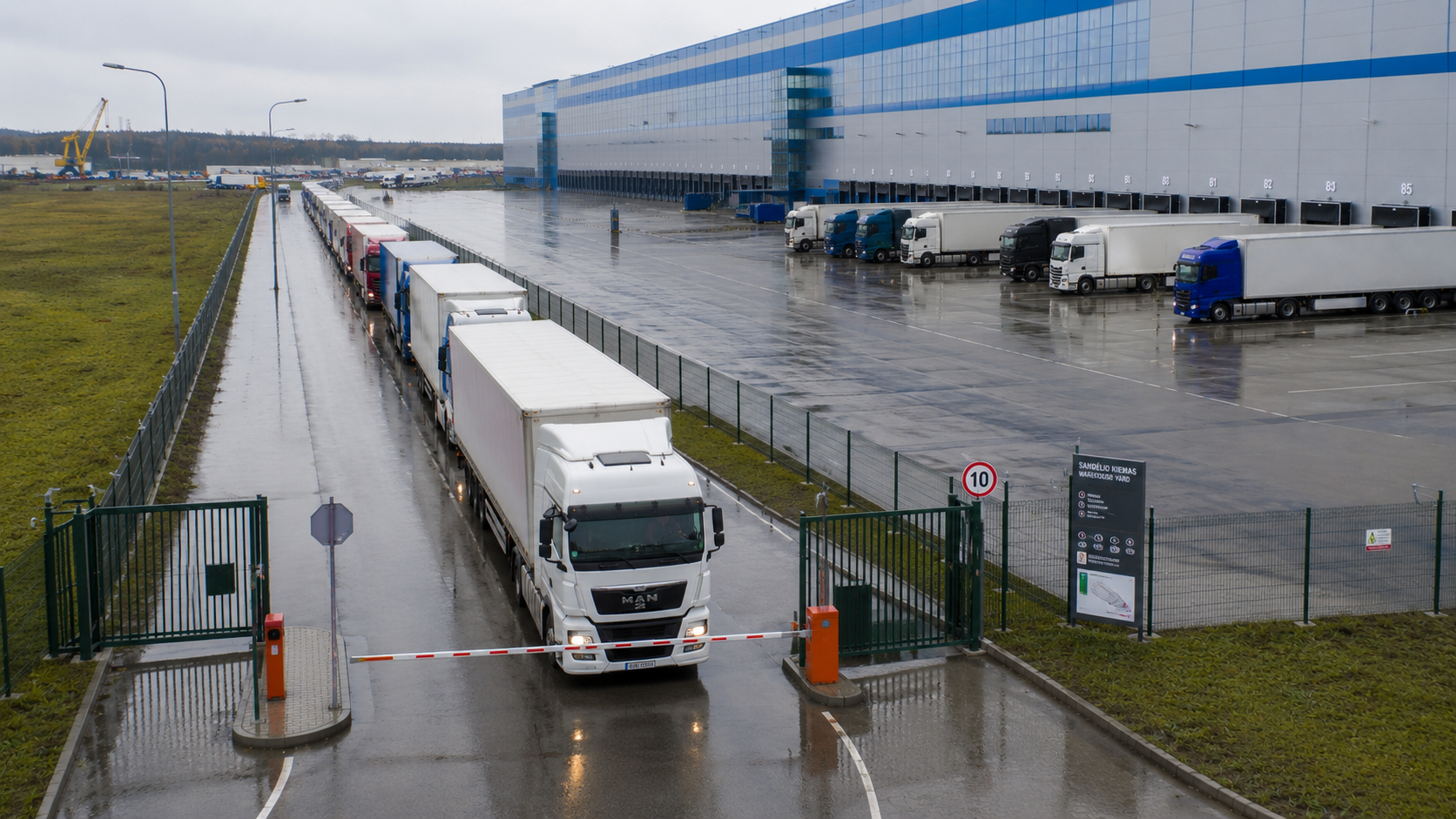

It is a scene every logistics or warehouse manager has seen more than once: a queue of trucks at the gate, drivers unsure which loading dock to pull up to, and a manager coordinating the schedule on paper or in an Excel spreadsheet. The cargo has not even reached the dock yet, and half an hour is already lost – every single day, with every single truck.
Inside the warehouse, companies have long invested in process optimization: WMS solutions manage the movement of goods, order picking, and inventory. But the yard – the area between the gate and the loading dock – often remains a "blind spot". And that's exactly where most invisible delays occur.
Equinox team spends a lot of time in warehouses, observing and analyzing intralogistics – we see this situation from the inside, which is why yard processes matter to us not as an isolated problem, but as a matter of visibility across the entire supply chain.
Yard Management System (YMS) connects three parties: the supplier or carrier arriving with the cargo; the warehouse team responsible for receiving or loading it; and the infrastructure itself – the loading docks, gates, and waiting areas.
In practice, that means:
The idea is simple: what used to be chaos and human memory becomes visible, plannable, and controllable.
Three factors are changing the rules of the game in logistics: fuel and labor costs are rising, customers expect greater delivery accuracy, and decisions increasingly have to be data-driven – if you cannot measure it, you cannot improve it.
A warehouse where yard operations are managed systematically gets tangible benefits: more evenly distributed work means less downtime; clear traceability allows objective evaluation of carrier reliability; and drivers who know where and when they are expected spend less time in the yard – a difference felt across the entire supply chain. In short: higher throughput, lower costs, and better control.
Yard Management System usually solves one specific warehouse problem – scheduling loading docks and arrival times. In practice, however, it is now common for finding a carrier for a particular cargo and booking its arrival time at the warehouse to happen as a single process: a supplier or warehouse finds a carrier for its cargo on a freight exchange and immediately "books" it, while the system simultaneously assigns that carrier a specific arrival time and loading dock at the receiving warehouse. For this to actually work, YMS itself must be capable of integrating with such exchanges rather than remaining a separate, closed system.
The same principle applies more broadly. Warehouses rarely run on a single system – WMS, YMS, and transport management tools often come from different vendors or get implemented at different times. What increasingly matters, therefore, is not the individual system itself, but its ability to communicate with other systems, even those built by an entirely different vendor. This depends not only on the system's architecture, but also on whether the team carrying out the integration has sufficient experience.
This means a company that already has its own WMS or ERP doesn't have to choose between "replacing everything from scratch" or "living with isolated data silos" – a professionally designed integration allows different systems to work together instead of competing for server space.
If your yard operations still depend on phone calls and Excel spreadsheets, it is worth viewing YMS not as a technical upgrade, but as a data source that you simply do not have today. Every minute spent in the yard is measurable – the only question is whether anyone is actually measuring it.
More broadly, the direction the whole industry is moving is clear: fewer separate, isolated tools, and more interconnected processes – from selecting a carrier to receiving the cargo at the warehouse.
Not all Yard Management Systems are equally mature. Most solutions on the market stop at a booking calendar – convenient, but essentially still a digital version of Excel. That's worth pausing on, because it's exactly where the real difference between "we have YMS" and "the yard is actually managed" becomes visible.
Several capabilities that currently distinguish a basic booking tool from a fully-fledged yard management solution (a level of functionality also supported by Equinox YMS):

None of these features is revolutionary on its own. Together, however, they achieve the same result – the yard stops being a "blind spot" and becomes a measurable, manageable part of the supply chain.

What's your experience – are yard operations in your organization already digitized, or do they still run on phone calls and paper?
Get in touch – we'll talk through what would work best for your situation.
YMS | WMS | SupplyChain | Optimization | Intralogistics